Friday, 20 January 2012

My 3 top places to visit in East Sussex

Rye


Rye is a very well preserved medieval town on  a hill top with car free  car cobbled streets and historical houses from the 16th and 17th centuries with a very Norman history and architecture style. Rye was once part of the Cinque Medieval Ports even today seems unlikely given that the  sea waters start to retire almost 5 centuries ago and now the town is already 2 miles from the sea, anyway still an important festival of  Scallop festival for the remaining fisherman fleet. But Rye is much more than an historic town, today the harbour is much alive, antique  shops, tea houses and fine dining combine together with unique bird watching, saltmarshes and romantic sandy beaches.

What to do in Rye

• Choice one of the three walks to the Rye Harbour Nature Reserve where oyster-catchers and curlews are the bird to spot.
• Visit the Georgian Lamb House where the American author Henry James used to live.
• Discover the local history in the Rye Castle Museum and the Normand style St Mary´s Church. Also visit the Ypres Tower (also town jail for 400 years) and enjoy the great views of the Rye harbour.
• Get lost in the street and discover the most fascinating antique shops and art galleries mainly in the Strand Quay area.
• In warm days is a must spend a beach day in the nearby dunes of Camber Sands.

Where to Eat in Rye
Mermaid Inn, Rye
Tea houses like Rye institution Fletchers House tea rooms is always a good option, but for is a must have a lunch or dinner in the another Rye institution Mermaid Inn, like another British historical inn´s they don’t live from the ghostly past or for celebrity visitors like Johnny Deep, their best thing along the rooms is the local food where lamb and oysters are the stars of the menu.

Where to stay in Rye
White Vine House is a luxury restaurant with period British rooms in the centre of the town.

Lewes

Lewes Castle gateway. Photo by Hackworth
The inland town of Lewes will really surprise you, Georgian and timber façades houses lined in tiny Saxon lanes and everything is crowned by the Lewes castle said  to be built by  William de Warenne (William The Conqueror’s brother in law) for show to the locals that the new Normand’s ruler will bring work to the area.

What to do in Lewes

• Visit the Castle museum
• Visit the house of Anne of Claves given to her by Henry VIII on the divorce settlement.
• Go to the local Victorian building of the Harvey´s Brewery.
• Get lost in the street, set aside your kindle and snoop on the several book shops.
• A day at  the Opera in the English institution that is Glyndebourne Opera House

Lewes Bonfire parade
Where to eat in Lewes
The Real Eating Company is a very  good option to have a very local fresh breakfast or brunch and at the same time buy some of the best local products, and Bills Produce Store on Cliffe High Street is also a good fun place with a nice selection of drinks.

Where to stay in Lewes
There are old coaching inns such as the White Hart and the Crown Inn  on the High street and the Shelleys hotel which has an old world charm and dates from the 15th century and ideal place to stay when the famous November 5th firework displays take place in and around Lewes. Pelham House in St Andrews Lane is another notable establishment with a magnificent garden with views over the Sussex Downs.

Beachy Head.


Must be my number one postcard from England, here the famous English coast white cliffs and chalky water colours have the addition of the bright red lighthouse that guard this coast plus the vertigo of walking in a perfect natural green turf make the perfect countryside day out. Few sea cliffs in Europe will capture your imagination and bring you the calm like in Beachy Head. The cliff are a clear reminder that England and France were once time ago joined and no separate by the English Channel, today one of the most undeveloped and beautiful English coast where in Beachy head the cliff plummets to 200 meters.
My favourite walk starts from the seaside resort of Eastbourne and finish in Cuckmere Heaven.

What to do in Beachy Head

• Start your walk in the Victorian town of Eastbourne visiting the pier and walking by the sea front.
• After you get a good photo of the Beachy Head lighthouse you next point will be the Belle Tout, the lighthouse that was moved in 1999 given the cliff eroding.
• Practice some fun sport. From Eastbourne before to reach the lighthouse exits a paragliding point; in Birling Gap is the surfer points and in Cuckmere Heaven canoeing and bike hiring is available.
• Cuckmere Heaven is a beautiful free development estuary with plenty wildlife and bird watching.
• Visit the Seven Sister Sheep Centre and meet the almost 40 sheep breeds from around the world .

Paragliding in Beachy Head
Where to eat
The Beachy Head Centre and the Golden Galleon are almost the only places, if you don’t want to ruin your day picnic is your best option and let the pub just for drink a refreshing beer. Another option is go to East Dean (not far for the Sheep Centre) and have a much better meal at The Tiger Inn.

Where to stay
Before or after all the walking take all the advantages of the more vibrant city in English south coast. Avoid the Grand Hotels of Brighton and the classic chain and let rest yourself in The Square Boutique Hotel or to the Trip Advisor winner The Twenty One bed and breakfast.


◦
Share/Bookmark

Wednesday, 18 January 2012

The Calamari Wars

Falklands Island wreck ship
After  already 30 years the Falklands waters are still rough, three decades have passed from the war British – Argentina conflict that has now come back to the first page of the diplomatic agendas of those two countries and commercial interested allies since a year ago was discovered new petroleum water marine reserve highly lucrative and since the British has been for 180 year from the colonial times and with little argument to go and sit down on a diplomatic table for justify their presence in the Falkland Island claimed from Argentina since 1820 and at only 500km from la Patagonia in the Argentinian Sea.
The David Cameron Government is looking  to create a protected marine zone around the South Georgia Islands (1300Km from Falkland Islands and also claimed by Argentina) with the reason if Argentina want to initiate any commercial or economic activity around they will need ask first for the British authorization.
Reached that point Argentina has launched several new measures, first asking their neighbours (Uruguay, Brazil and Chile) to not allow British flag ships with Falkland Island destination stop in their ports and the second measure is encouraging Argentinian fisherman’s to prevent the squid (Illex type) that start their life in the River Plate water to reach the Falkland’s waters.

Illex Squid. Photo by NOAA
For almost two decades Argentina and the Falkland’s islands co-operated on sustainably fishing of the squid. But now the Federal Fishing Council allow to fish two months early with the idea to catch the squid before to start their migration to the Falkland Islands for feed before move  to deepest water to breed and die. Catching so early the squid when still small can damage the stock, apparently Argentina allow that something similar happen with the southern blue whiting now unviable for commercial exploitation. Falkland’s economy is highly dependent of their fishing licence sales where the Illex Squid species is the most valuable. The Falklands Squid season will be start late this February where fisherman boats for the big fishing powerhouses like Spain, Russia, Japan and Korea will be waiting for a legal catch meanwhile another 100 fisherman fleet mainly from China and Taiwan will be catching also the very appreciated Illex Squid in East Asia.

At the moment seem like the only loser are the Ilex’s and again the ocean biodiversity and the winners the same fat cats as always.

Squid Nutrition Properties x 100g

Calories
Protein
Fat
Phosphorus
Potassium
Iron
81
17
1,3
221
90
1,7


More about the conflict: 

More Argentina dirty politics:  Trained dogs searching for dollars

◦
Share/Bookmark

Monday, 16 January 2012

Pasta Soup´s recipes

Ravioli Soup
This week am stopping my pasta fever for a while (See Seafood pasta special ) and to use my leftovers with frozen fresh pasta I will share with you a couple of fresh pasta soups to warm you up on these chilly nights - just in 30 minutes in cooking and preparation.

Sorrentinos Soup  Serves 4 – Kcal 380 - Time 20 minutes

Tortellini Soup
For both of the fresh pasta recipes you can use your own home-made pasta, like ravioli, sorrentinos and tortellini's or also you can use the packet supermarket versions but please before to buy check first the salt and fat saturates content.

You need: 200g tortellini – 3 salad onions -  ½ chilli (chopped) – ¼ tsp ground nutmeg – 1 tsp fennel seeds – 150g frozen spinach – 100g frozen green beans – 50g parmesan cheese (grated) – 750ml vegetable stock.

1. Heat 1 tbsp of olive oil in a large saucepan in a medium low heat. Fry the chilli and salad onion for 2 minutes. Then add the fennel and the nutmeg. Stir
2. Pour in the vegetable stock, wait to boil and add the spinach; simmer for 2 minutes.
3. Add the frozen beans (use fresh ones in summer) and the ravioli. Cover the pan for 1 minute and then wait until the raviolis rise to the surface (3-4 minutes)
4. Serve in individual soup bowls and scatter over the parmesan.

How to make your own fresh pasta

Ravioli Soup Serves 4 – Kcal 340 – Time 25 minutes.

This is a very similar recipe to the Sorrentinos or Tortellini Soup with the addition of shredded chicken that makes the dish in a more substantial meal adding around 25g of protein by serving. If you have already some cooked chicken in the fridge you can jump step 1 and 2.
Chicken with courgettes
You need: 200g ravioli -  1 onion (chopped) – 1 fennel bulb (chopped) – 2 garlic cloves (sliced) – 2 courgettes (diced) 150g frozen green beans – 150g green beans – 1 breast chicken fillet (around 200g) – Parsley for serve.  1tsp of smoked paprika – 1ltr chicken stock.

1. Rub 1 tsp. of smoked paprika, salt and pepper all over the chicken fillet(s). If you have time cover with a clean film for at least 30 minutes.
2. Heat 2 tbsp. of olive oil in a large saucepan in a medium low heat. Cook slowly the chicken fillet until is done (about 10-15 minutes). Set aside. When cool down shred the chicken.
3. In the same pan add the onion, fennel and garlic and sauté for 5 minutes. Add the chicken stock. Bring to boil.
4. Now add the courgettes and after two minutes add the beans , peas and raviolis, cover for 1 minute and simmer until the raviolis rise to the surface (3-4 minutes).
5. Serve in individual soups bowls; top with the shredded chicken and some chopped parsley.

How to make your own fresh pasta

Chicken Noodle Soup.  Serves 4 – Kcal 290 – Time 25 minutes.

Like an extra recipe I like to share one of my favourites feel good recipes from my Kitchen Waitrose Magazine´s by Australian chef Bill Granger even I change some of the cooking step for make it more easy and familiar with the recipes above.

 The mix of oyster sauce, lime vitamin C and chilli will boost your system and clear up your nose.
250g fresh egg noodles – 4 tbsp oyster sauce – 1 tbsp caster sugar – 2 tbsp lime juice – 2 chicken fillets (around 300g) 3 pak choi (shredded) – ½ red onion (sliced) – ½ red chilli (sliced) – 1.2 ltr chicken stock.
1. Rub 1 tsp. of smoked paprika, salt and pepper all over the chicken fillet(s). If you have time cover with a clean film for at least 30 minutes.
2. Heat 2 tbsp. of olive oil in a large saucepan in a medium low heat. Cook slowly the chicken fillet until is done (about 10-15 minutes). Set aside. When cool down shred the chicken.
3. In a sauce pan bring the stock to boil, then add the oyster sauce, sugar and lime juice.
4. Add the noodles and cook following the packet instructions (2-4 minutes) and at the same time the Pak Choi.
5. Serve with individual soup bowls with the chicken, scatter over some coriander leaves, onion slices and the chilli.


◦
Share/Bookmark

Friday, 13 January 2012

´KitchenVoyage Food Calendar 2012


KitchenVoyage Seasonal Food Calendar 2012 has arrived!  and this year with some of the best food festivals around the world. A lot of new ingredients are waiting to be used in our kitchen, just download The KitchenVoyage seasonal food calendar to know what to cook in this season. Remember eating according to the season is healthier, eco-friendly and cheaper!


Download for Excel 2010


Download for Google Docs and Excel 2003-2007

Notes.
* Please confirm Food Festival dates before you go.
*If you have some troubles downloading please contact me


◦
Share/Bookmark

Wednesday, 11 January 2012

Oranges your winter best friend

Photo by Lovestruck
This winter in England has been relativity mild and some of the Hospital has notice a big affluence of patients due the quantities of virus around.  And given the financial crisis and the increasing competitiveness in the job the worst can happen with you is stay a whole week in bed with a cold. One of the best things that you can do for help your body to combat the winter pathogen is have an orange a day. One orange a day covers the daily recommendation intake of Vitamin C by day - Something you don’t expect to be advertised in pharmacies and TV ads-
Oranges  are also rich in minerals (magnesium and potassium) and anti-oxidants and fibre.
Oranges it is believed  started to be cultivated in China and is a possible hybrid between pomelo and mandarin they are available all year around their natural season is from middle autumn until first day of the summer.
Despite their sweetness the orange only has 36, 5 kcal by 100g (around 70 kcal by piece) and also the intake of orange will help against cardiovascular problems and the bad Cholesterol: Low-density lipoprotein (LDL). Their high level of folic acid help pregnant women and the anti-oxidants help to keep young your body.

Seville orange marmalade by Basecadet
Exist several oranges varieties, the British favourites are the Seville oranges in season now and are perfect for making marmalade. When you go to the market to choose your perfect orange you need to look more for the weight than the colour. More weight means more juice. Like another fruits is recommended to keep fresh in the fridge trying to avoid contact between each other.
To obtain the properties of the orange is preferably eat it in its natural state, make a juice is a great option also although you will miss some of their fibre. If you make a juice consume immediately to not lose any of the properties. Even if you refrigerate most of the vitamin will be lost after 30 minutes.
Mandarin, grapefruits, pink grapefruits are also in season and have similar benefits.

More: Orange juice prices hit record and the fungicide Brazilian juice in USA


Three Seasonal oranges juices to make at home before going to work


Plenty of Vitamin C in a morning juice. Photo by helter-skelter  
Orange juice with 
Grapefruit
Juice 1 grapefruit – 1 orange – 1 lime – and dilute with 75 cold sparkling water.


Carrot and Beetroot.
Juice 1 large orange, 175g carrots, 100g beetroot and 100g fennel


Orange Powerful Smoothie
Juice 1 large orange and a whole carrot. Transfer to a food processor and add 1 unpeeled frozen banana plus one dried apricot and some ice cubes. Blend and serve.


◦
Share/Bookmark

Monday, 9 January 2012

Argentina Pasta recipes

Windows shop with Gnocchi´s in Buenos Aires. Photo by Jessica
Even though I try to focus with Mediterranean food and British food, this New Year I will bring to you some of the recipes from Europe that become very popular in South America after the big migrations of the 20th century from Europe to the Americas.

It´s well known that Buenos Aires like New York was flooded with Italians during and after the II World War and with them they bring all their recipes. Argentina is worldwide famous for its quality beef, but also in the cafes and restaurant of Buenos Aires the pizzas and pasta are the also the star dishes at the Argentinian homes.
I share 3 recipes that always enjoyed when I was living in the River Plates coast. The first the popular raviolis with a tasty meat sauce called Tuco a real adaptation to the dish, the another are the ñoquis (gnocchi’s)  where every 29th of each months is traditionally to have it putting some money under the plate for luck. And then you can try the sorrentinos, another popular fresh fill pasta known as Sorrentinos it´s believed that was invented in the vanished restaurant Sorrento in Buenos Aires,  although the origin must be from some forgotten town of south Italy.

Potato Gnocchi.  
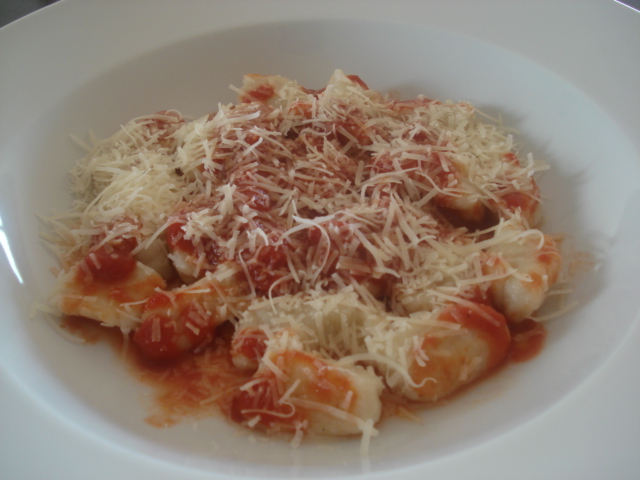
Ñoquis with tomato sauce and parmesan cheese
You need x 4 -6 serves: 1kg waxy potatoes (scrubbed and unpeeled) – 250 to 270g of flour – 1 egg – 25g butter (softened). 1tbsp of salt – ½ tsp of grated nutmeg. Parmesan cheese to serve.

1. Bring to the boil a salty pan of water with the potatoes in. Cook until the potatoes are tender but not falling apart. Drain, let cool down until you can manage the potatoes and so you can peel them.
2. Mash the still hot potatoes using a food mill or similar, then spread some flour over a work surface and drop the mash potatoes onto the work surface.

Gnocchi mash
Cutting the Gnocchi´s

3. Now sprinkle over with half of the remaining flour and mix lightly.
4. Add the egg to the mixture plus the nutmeg and knead lightly, adding the remaining flour when it´s necessary. When the dough is light to the touch and no longer sticky is ready to be rolled
5. Divide the roll into 4-5 parts. In a new floured work surface, roll each dough until you have a dough stick of about 2,8cm of diameters. Cut with a floured knife into pieces of 2,8cms long.

Making Gnocchi s with a fork
Traditional Gnocchi shape

6. With a common table fork, one by one press and roll lightly with your thumb the gnocchi over with the fork prongs.
7. Bring to the boil a large pan of salty boiling water and drop your gnocchi’s in. Be sure they have space. Best cook in 2-3 batches. When the gnocchi rise to the surface after 3-5 minutes the gnocchi are done. 
8. Drain and put them in a serving dish, cover with a tomatoes sauce and sprinkle some parmesan cheese

Raviolis with Tuco sauce
Ravioli with Tuco sauce
You need x4 serves
Ravioli dough:  500g plain flour – 2 white eggs – 1 egg – 1tsp of salt – 2 tbsp olive oil.

Ravioli filling: 400g fresh spinach (washed) or 180g frozen spinach – 175g ricotta cheese – 70g parmesan cheese – 1 egg – ½ tsp grated nutmeg.

Tuco sauce: 1 small onion (chopped) 50g red pepper – 50g green pepper (both finely chopped) – 2 grated carrots – 2 can chop tomatoes – Pinch of nutmeg – Bunch of parsley.
400g of stewing beef (also used silverside or shin of beef) in chunks.

Ravioli dough.
Ravioli dough well
1. In a big bowl place the flour with salt and make a well in the centre. Break onto the middle the egg whites and the whole egg, plus the olive oil.
2. Start beating the eggs with a fork and gradually drawing the flour from the inside walls of the well. As the paste starts to thicken continues mixing with your hands until you have dough, adding more flour if still sticky or some lukewarm water if it is too dry.
3. Spread some flour over a working surface and knead the dough for about 10-20 minutes, until the dough is smooth and elastic. You can also with this dough smash onto the work surface time to time. Cover with a cling film and let rest for 1 hour.
4. Split the dough in 2.  With a floured rolling pin flat the dough into a disc until you has less than half centimetre thick (ideal 3 mm like a kitchen towel). When is ready with a cutter create rectangle for approx. 30cm long and 10cm wide. 

Ravioli filling. (Meanwhile you are resting the ravioli dough)
1. In a saucepan with some depth, put in the spinach without draining and cook in a gently heat for 5 minutes covered. Drain and let cool down squeezing out as much moisture as possible. Reserve the moisture. Chop very finely the spinach.
2. In bowl combine the spinach with the ricotta, egg, parmesan and nutmeg. Season with a pinch of salt and a good quantity of pepper and mix all very well. Cover until you need to use it.

Making the raviolis

Place the filling in the sheet
Cover and remove the air with your fingers.

1. In a lightly floured working surface, place half of the pasta sheets. 
2. Then place small teaspoon of filling over the centre of the pasta sheets in rows with a separation of 5 cm each other.
3. Cover with another sheet of pasta, pressing down gently and removing any air pockets and selling with your hands the sheets as good as you can

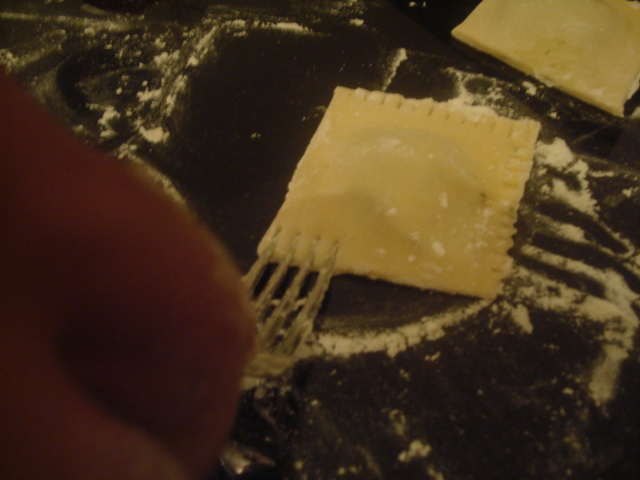
Sealing the raviolis with a fork
Cook the raviolis in salty water

4. Using a fluted pastry wheel or a pizza cutter cut between the rows to form the classic ravioli shape. If you don’t have a fluted wheel, seal the ravioli pressing with a fork the edges.
5. Let rest the raviolis for at least 30 minutes in a floured surface.
6. Bring to the boil a large pan of salty boiling water and drop your raviolis in. Be sure they have space. Best cook in 2-3 batches. When the raviolis rise to the surface after 3-5 minutes the raviolis are done. 
7. Drain and put them in a serving dish, cover with the Tuco sauce

Tuco sauce:
1. Heat 4 tbsp. of olive oil in a sauce pan at medium low heat. Sauté the onions and peppers for about 5 minutes.
2. Add the meat chunks and laurel leaves. Brown the meat. Add the carrot and stir
3. Add the tomatoes and season. Simmer until the meat is tender about 2 hours (depending of the kind of meat that are you using)
4. Turn off the heat and add chopped parsley. At the end I like to fall apart the meat.

Sorrentinos 
Sorrentinos argentinos
You need x 4 serves
Sorrentinos dough: 500g flour – 2 tbsp olive oil – 1 tsp of salt – 1 egg yolk- Lukewarm water.

Sorrentinos filling: 400g ricotta cheese – 100g mozzarella cheese (grated) 150g York ham (finely chopped) – 50g parmesan cheese – 1 egg – ½ tsp grated nutmeg.

Sorrentinos filling: 
1. In a big bowl mix very well the entire sorrentinos filling. Season with salt and pepper, cover and set aside.

Making the sorrentinos
Sorrentinos ready to cook
1. In a big bowl place the flour with salt and make a well in the centre. Break onto the middle the yolk egg, plus the olive oil.
2. Start beating the egg with a fork and gradually drawing the flour from the inside walls of the well adding at the same time a tiny splash of the lukewarm water. Add more flour if still sticky or some lukewarm water it is too dry.
3. Spread some flour over a working surface and knead the dough for about 10-20 minutes, until the dough is smooth and elastic. Cover with a clean film and let rest for 15 minutes. 


Shaping sorrentinos without pasta accesories
Filling Sorrentinos

4. Split the dough in 2.  With a floured rolling pin flat the dough in floured work surface  into a disc until you has less than half centimetre thick (ideal 3 mm like a kitchen towel). When is ready with a circle cutter of at least 6cms. diameter cut the dough.
5. Spread the dough circle over a floured working surface, then place small teaspoon of filling over the centre and cover with another dough circle. With your fingers press down gently and removing any air pockets and sealing with your hands the sheets as good as you can.
6. Seal the sorrentinos pressing with a fork the edges.
7. Bring to the boil a large pan of salty boiling water and drop your sorrentinos in. Be sure they have space. Best cook in 2-3 batches. When the sorrentinos rise to the surface after 3-5 minutes the raviolis are done. 
8. Drain and put them in a serving dish, cover with your favourite sauce.


Fresh Argentinian Pasta Notes.


*Like in Italy in Argentina they use any kinds of accessories for make the pasta recipes quicker and with a professional look. Pasta machines, pasta shape cutters and pasta sieve or spoon sieve are a must in every Argentinian kitchen. Today are easier to find on-line or Italian gourmet shops.
*For remove the pasta from the boiling water is recommended use a sieve spoon or a pasta sieve, for avoid any braking. Fresh pasta is much more delicate than dry pasta.
*Before cooking the pasta can be frozen for up to 3 months.
*With the leftover dough(s) you can make pasties to cook in the oven or spaghettis.


Three easy tomatoes sauces recipes

◦
Share/Bookmark

Friday, 6 January 2012

Three wise men cake recipe

Photo by http://blog.dimehoteles.com
Los tres reyes magos  (Three Wise Men)  were, according to Christian beliefs, a group of distinguished foreigners who visited Jesus after his birth, bearing gifts of gold, frankincense and myrrh. They are regular figures in traditional accounts of the nativity celebrations of Christmas and are an important part of the Christian tradition. In Spain (and also in some South American countries and Mexico) the 6 of January is the time for the children and families to receive gifts almost in the same fashion like Santa Claus. You first need to write a letter to the three wise kings, and the 5th of January eve before to go to bed you need to get ready some drinks or food for the three kings and some water or grass for the camels. If you have been a good boy all year at the 6th of January morning you can receive some gifts, if you were bad boy charcoal is awaiting for you.

Three Wise Men parade yesterday in Madrid. Photo by Larazon.es
For more than 120 years also is traditional in almost every respectful town have a parade the day before where the three wise kings represented most of the times for local authorities throw to the kids and public candies for let know everybody that they are in town.
After all the illusion, some anticipation and emotions that create to see the 3 kings and open the present nothing better after all the excitement of the 6th of January than to  share a “Roscon de Reyes” (cake of the kings) with the families and friends. The cake of the kings if one of the most expected seasonal foods in the Spanish calendar of sweet confections. Unfortunately and like is usual the food industry has converted this cake in a bomb of trans-fat, excessive calories and full of artificial flavours.

 Most of the best bakery have their own version, but even they can be very good are not cheap. Since last year blog leader webosfritos and Robin Food publish online, easy to make and tasty recipes, seems like much of Spanish families are cooking more and more this famous cake looking for the old tasty flavours.

Cake of the King’s recipe

My home made king´s cake
Difficulty: Passion and care. Time: Base dough 10 minutes. Main dough 5:30 hours. Ring Dough 2:30 hours. Cooking 20 minutes. Kcal: Around 200kcal by piece.

You need:  
Base dough:  70g whole milk (lukewarm)  - 10g fresh yeast - 1 tsp. caster sugar – 130g strong flour

Main Dough: 60g whole milk (lukewarm) – 70g softened butter (cubed) – 2 eggs – 20g fresh yeast – 25g orange blossom water - 450g strong flour – Pinch of salt.  120g icing sugar – ½  grated lemon skin – ½ grated orange skin.

Decoration:  2 beaten egg – vanilla sugar – candied orange peel and/or candied fruit –
Surprise: The 3 wise king cake always came with a surprise, traditionally was a hidden broad bean in the dough; today a small plastic figure (religious or popular cartoon character). The finder of the figure will be the king of the day .

1. Mix in a bowl the icing sugar with lemon and orange skin. Set aside.
2. For the base dough mix in a bowl the lukewarm milk with the 10g of fresh yeast, dissolve and add the sugar. Then add the flour, mix very well and make a dough creating a ball shape. In a big clean bowl full of lukewarm water put in the dough ball in the centre and wait around 10 minutes until the ball float. Now is ready to use. Set aside
3. Now we can start with the main dough.  First in a big bowl mix the lukewarm milk, 20g fresh yeast and dissolve very well.
4. Sift the flour in and add the butter, eggs, salt, orange blossom water, pinch of salt and the mix of icing sugar with grated orange and lemon skin. Mix a bit. Then add the base dough to the bowl and mix all very well and quickly.
5. Grease or oil a working surface and move on the bowl mix. Let rest 3 minutes.  Grease or oil your hands and start to make dough, by hand will take around 10 minutes until you have elastic dough.

King´s cake lifted dough
6. In a warm dish or bowl let rest the dough between 4 and 5 hours in a warm room temperature until the dough has duplicate their size. If you don’t have a warm environment, pre- heat your oven until 50ºC. Turn off and after 15 minutes put your dough in. In any case cover your dough with a cling film or a cloth
7. After the dough has duplicate it´s size, remove very careful the airy dough from the bowl. Now you can split the dough in two or just make one very big using all the dough. In any case work for 2 minutes the dough for remove some air from the dough. Then let rest for 10 minutes in a working surface. Cover with a cloth.

Traditional ring shape
Brushing the kings cake

8. Now is time to give the dough the classic ring shape of the kings cake, for that poke your fingers through the centre of the dough to make the ring shape and carefully rotate the dough with your hands to even out the size of the ring. (Watch video minute 20)
9. Set the ring in shallow grease oven try (or oven paper). Let rest for 2 minutes or 3. If shrink a few just expand the ring again. Now is time to hide the surprise in the ring.
10. With a brush carefully coat the entire ring with the beaten egg. Don’t push too hard the brush or the dough can go down.
11. Cover the dough with a light cloth or kitchen paper and let rest for 1:30 to 2 hrs. until the ring has double up its size.
12. After the 2 hours, preheat the oven at 200ºc

Decorated King´s Cake Ring
13. Again coat with beaten egg very careful and decorate with the candied orange or candied fruit, sprinkle some flake almonds and vanilla sugar. You can use also some normal sugar just wet.
14. Put the king’s ring in the oven for 18-20 minutes. In the last 10 minutes drop the oven temperature to 180ºC and cover with foil paper for avoid to get too dark. Cook until golden brown. Remove from the oven ald let cool down in a rack.
15. Serve with a hot chocolate (traditional)  or with a nice lady grey cup of tea!

Note: If you don't find fresh yeast, you can use dry. 5,5g of dry yeast is equal to 16g of fresh yeast.
◦
Share/Bookmark