Sunday, 15 May 2011

Glasgow, the Scottish creativity city.


Merchant City
  Always I am going to Scotland i feel I trespass a magic frontier and I get in a mystic land, with a fairy-tale landscape and cities that show us the opulence and decadence that the Scottish had suffered.
But after years of poverty, Scotland has become a risen economy thanks to the petroleum, the tourism and the attractive of their culture.
Edinburgh is the aristocratic capital of the country but Glasgow for centuries has been the “ugly one” but luckily like in Bilbao, the city had found its way to be an architectural and cultural stand out and the place to go shopping in Scotland and north England.

The best way to arrive to the city must be by train but unfortunately United Kingdom has forgotten its old railways glories and to travel 400 miles by train takes you about 4:30 hours, at least they still doing good weddings.
So we arrive at the windy airport of Glasgow in uncommon hot sunny day. After our check-in the first walk is the Merchant City, the old rich merchant district that flourish with the lords that make fortune with cotton, tobacco and textile industries. After 1750 until 19th centuries the merchant city get rich and develop beautiful buildings like the Trades House, the Hutcheson’s Hall, Tobacco Lord´s House and another grand Victorian buildings and neo classical like the actual Modern Art Gallery.  At the moment the historical buildings with their clean facades,  just remind me of Edinburgh, but you look more closer in the narrow alley you discover the black walls, the street musician, that is just not the typical pipe, they play songs of Texas and even the newest of Belle & Sebastian.
Before to leave the area is mandatory go to George Square and contemplate the Victorian buildings around and the statues of Walter Scott, Queen Victoria and the lions.
After a short walk you will be in the Scottish golden Z, a bunch of walking street that form a Z, and where are the most popular shopping centres, and high street shops.  Even if you are not fancy to shop some of them worth a visit like the Buchanan Galleries, Princes Square and glass structure of the St Enoch Centre. Also the Argyll Arcade built 1827 are nice to visit with their jewellery shops but if you like something more alternative you must go to the Barras Market, you will be surprised!
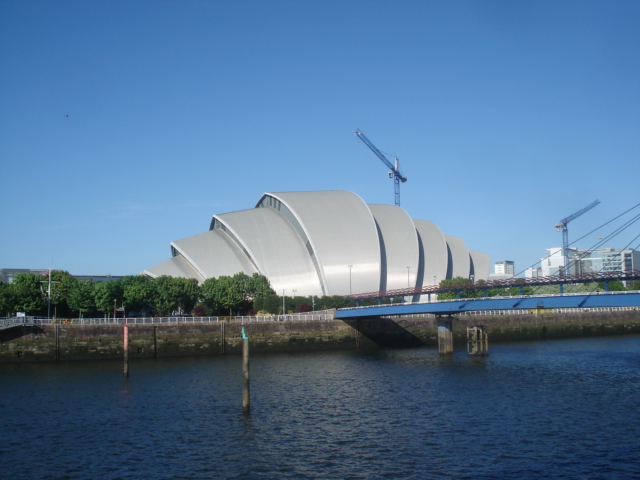
Armadillo by Foster

But now is time to move, and ahead to the futurist design over the side of the Clyde River that offer the Science Centre and the Conference Centre, called by the locals the armadillo, even the Norman Foster architect try to emulate a sea shell and to my taste one of his worst attempt when you are getting closer to the building. As well you can contemplate a giant ship crane that reminds us of  the historical past of the docks and the Clyde river; that I am pretty sure than for centuries has never been look so clean. And now the area has a new arrival the new spectacular transport museum (open 21st june).

Inside Kelvingrove museum
After this you are ready to back to the city and visit the Great Western Road, a posh area close to the Glasgow University, and Kelvingrove museum. The Kelvingrove  is a Victorian red palace where you can find a taxidermist elephant, French impressionist and Flemish painting, some art for the Scottish boy, Mackintosh  and even a Spitfire from the second world war. Even the display is quite chaotic in some stages, they have a lot of information to learn about what are you watching, really much better than the disappointed visit of the Modern Art Museum, a real waste of time if wasn’t for the nice interior of the buildings.
Anyway Glasgow have around 20 museum and galleries, most of them are free, the Burrell Collection is the art collection of one of the richest shipping merchant of the city and include more than 8000 pieces, including Rodin, Cézanne, Greek and Egypt object. No far you can find the Pollock house for admire Spanish painting of Goya, Murillo and El Greco.
Kibble Palace
 Much of the expert believe that the word Glasgow mean “dear green place”, we can be sure but is true that Glasgow is one of the European cities with most green space for habitants, and prove of that are thebotanic gardens with impressive Kibble Glasshouse, iron and glass in their more beautiful expression manage to keep a tropical forest inside.
Before to leave you need to explore the Charles RennieMacKintosh universe, he was an architect, designer, and artist that change the stone for the iron and glass transforming everything in more functional and simple without left the beauty and harmony with the nature. The best examples of his art are in the Hill House (Helensburgh), Willow Tea Rooms or Glasgow School of Art.
Loch Katrine
 Another good thing about the city is that Glasgow is the perfect springboard to the Scottish countryside and history, Loch Lomond biggest of all of them is a short drive, you will astonish with the lake view and charming bed & breakfast around them.  Also you are not far from the Lowlands, maybe with less fame that the Highland but they are rich in history with famous battles and heroes like William Wallace. The natural park of the Trossachs  known as the Scotland in miniature because of its stunning scenery, is home of another Scottish character the anti-heroe Rob Roy MacGregor a kind of Robin Hood but with the difference he kept the cattle stole from the rich for himself. Inside the park is the Loch Katrine, were you can make a cruise in a steamship boat meanwhile you understand surrounding for the beauty of the lake why sir Walter Scott´s wrote the epic poem “The Lady ofthe Lake”.

Maybe for the outsider to United Kingdom driving in the narrow path of the Scottish countryside is not the best option. We recommend Timberbush Tours for enjoy Scotland at its best

Where we stay.
Bedroom - Gran Central Hotel
We stayed here at the beginning of May. The former Central Hotel has had a £20 million pound refurb to restore it to its former glory. The public rooms echo the grandeur of Victorian times but with a 21st century design.
Hotel facilities are limited at the moment but will include a gym and high level terrace once the work on the upper floors is complete. There is a lovely champagne bar which overlooks the station concourse as well as many rooms for corporate conferences and functions.
The ballroom is a tour de force and very elegant and now used for social occasions and conferences/presentations.
The Grand Staircase is equally stunning with a huge chandelier which cascades down from the fifth floor.
We had a room on the fourth floor, of a largish size and a good sized bathroom. The room was well soundproofed from the station below.
However the amenities were somewhat below  for a 4 star hotel. No mini bar, no heating or towel rails in the bathroom and a poor tv service which was difficult to control with the remote.
Breakfast was of the buffet style in an elegant room with Venetian style chandeliers but coffee/ tea service was intermittent at best.
The hotel is well located for the various attractions of Glasgow and I am sure that once the refurbishment is completed and small issues ironed out, The Grand Central Hotel Glasgow will be a superb place to stay in the centre of Glasgow.

Where we eat .


The Ubiquitous Chip

Set in vibrant Ashton Lane this is one of Glasgow’s best restaurants. The building, a converted stable block is charming and well decorated with a fish pond just inside the entrance.
Opposite is a well-stocked bar with vintage wine bottles stacked horizontally below.
To eat my we had the traditional Scottish haggis as a starter which was beautifully cooked and very tasty and a salmon salad which was well presented and very satisfying.

To follow we had Venison medium rare with roast potatoes and a selection of vegetables.
Again beautifully cooked and tender meat and a Scottish sirloin steak served medium rare. This was possibly the best steak I have ever had..full of flavour and very tender almost melting in the mouth.

We had a bottle of a rather good California Red, Vintage 2005 to go with the food.
We shared a dessert of Scottish Oat and Vanilla Ice Cream which finished off a truly spectacular meal.
Our waiter David was welcoming on arrival and gave us a wonderful table on the ground floor.
Highly recommended for traditional Scottish dining! Price a hefty £125 for two but well worth it.

Roganos
An Art Deco institution since 1935 in Exchange Place this restaurant specialises in fish dishes and does not disappoint.
We had the Fruits de Mer platter which was an orgy of mussels, oysters, shrimp and crab and a salmon roulade to start followed by Lemon Sole with new potatoes and spinach.
We had a bottle of Alsace wine with the meal which went down very easily!
Attentive service in elegant surroundings this is must for lovers of all things fishy.
Price £107.00 for two

The Grill on the corner

Situated near our hotel the Grand Central this is a trendy eclectic cavernous place popular with young and old alike. The food is not of the same standard as the above but is well cooked and presented. Service is friendly and efficient. This time our dishes were a ginormous rack of ribs which hid a mountain of chips plus a bottle of Brahma beer to wash it down and a Dublin bay scampi and chips with a large glass of Sauvignon Blanc.
We left both full and satisfied from the large meals we had eaten. Price around £56 for two

And finally...

Ketchup

A return visit to Ashton Lane for the best burgers and fries in Glasgow.

A Ketchup Burger & Ketchup interior room.


Popular with the student crowd and their teachers alike. Sitting at high tables on bar stools this place has a certain 1950s retro chic going on many different varieties to choose from best served with their own brand of tomatoes ketchup which was delicious. We washed the meal down with Scotlands favourite non-alcoholic beverage Irn Bru ! ◦
Share/Bookmark

Wednesday, 11 May 2011

Gazpacho!!

Tomatoes, gazpacho main ingredient

Find the original recipe of the gazpacho or even the origin of the word has been a lost study case for the historian, mainly because exist equal quantities of gazpacho recipes like andalucian families, and is a dish created by peasant that can´t  access to read or write, so the origin is not documented. Gazpacho is a dish that was consumed by peasants in the field during the harvest, they needed something nutritious and at the same time refreshing, to cope with the hard work and hot weather.
The earlier gazpacho dated from when the south of Spain was under Arabian control the gazpacho was made just with garlic, olive oil, bread and almonds, today in some areas they are still doing and is known as white gazpacho.
Later on with the introduction of new vegetables coming from the Americas like tomato and pepper, the gazpacho takes the color that we know today. And even today with the demands of the tourist industry and new modern cooking technique the gazpacho continues  its evolution always providing us with  nutrients and flavour.
The gazpacho is very easy to make, and now more than ever with the juicing or blender machines, but still quite tricky to find the correct balance between the ingredients, for that reason gazpacho in tetra brick like Don Simon becomes summer by summer more popular in the Spanish tables, even everyone knows that gazpacho like our mothers can’t be beaten.
       Kitchen Voyage trip to Seville

   Gazpacho recipes.

Classic Gazpacho.
Bowl of Gazpacho
 3 slices of white bread (without crust about 200 g)
500g ripe tomatoes or british red choice tomatoes.
1 cucumber (peeled – seeded – diced)
1 green pepper (seeded – halved)
3-4 cloves of garlic (peeled)
125 ml olive oil
2 tbsp sherry vinegar.

1.    Put the bread in a bowl and pour a glass of water, soak by 30 min.
2.    In a blender put the rest of ingredients (reserve the vinegar) and blend for 1 minute. 
3.    Remove the bread and drain any water excess.
4.    Add the bread to the blender and blend until you get a nice consistency, if is too heavy just add more water. For me must be creamy but some people like more drinkable. So this point is up to you. You can sieve the cold soup if required.
5.    Now season with salt and the 2 tbsp. of sherry vinegar.
6.    Refrigerate for at least one hour and serve in very cold individual soup bowls.

Real Salad Gazpacho.

30 g stale white bread (torn)
300g ripe tomatoes or british red choice tomatoes.
1 ltr chilled tomato juice
3 eggs (hard boil). Then separate the white from the yolk
½ cucumber (peeled – seeded – diced)
1 red pepper (seeded – halved)
4 salad onions (thinly sliced)
1 red chilli (thinly sliced and deseeded)
2 garlic cloves (crushed)
1 tsp chopped oregano leaves
4 tbsp olive oil
4 tbsp red wine vinegar
2 tsp Dijon mustard
Little ices cubes.

1.    In a big bowl mix mustard, olive oil, vinegar, bread, garlic, and hard boil egg yolk, and paste with a fork
2.    Add the vegetables and tomato juice. Mix everything very well.
3.    Season with salt and pepper. And chill in the fridge for at least 1 hour and serve in very cold individual bowl soups.
4.    Pour over each bowl the white eggs chopped with a few oregano leaves and some ice cubes. And then sprinkle over a little olive oil.

Ham and quail egg Gazpacho.

250g white bread
500g ripe tomatoes or british red choice tomatoes.
¾ cucumber (peeled – seeded – diced)
1 green pepper (deseeded – halved)
2 cloves of garlic (peeled)
125 ml olive oil
2 tbsp sherry vinegar.
250g Serrano ham shredded
2 quails eggs (hard boiled)

Follow the step above. When you are ready  to serve  sprinkle over every bowl the Serrano ham and add on the top half quail egg. 
This recipe is interesting because you add some protein to the dish.

Adding water you can Gazpacho like a drink
Macerated Gazpacho (1 day preparation)

500g ripe tomatoes or british red choice tomatoes roughly chopped.
3 black peppercorns
250 ml tomato juice
4 basil sprigs (leaves only)
1 red pepper (seeded -cut in strips)
½ small yellow pepper (seeded - cut in strips)
1 garlic clove (peeled – chopped)
1 thyme sprig (leaves only). 1 bay leaf
2 tsp balsamic vinegar. Some olive oil.
2 slices of white bread

1.    Mix in a bowl the chopped tomatoes, peppercorns, tomato juice and half of the basil leaves, and cover with a clean film. Put in the fridge for at least 2 hours.
2.    In a medium heat pan with a few olive oil sauté for around 8 minutes the stripped peppers, with the garlic, bay leaf and thyme and the rest of the basil. Season with salt.
3.    When the peppers are soft (avoid any browning) remove from the heat and tip onto the bowl of tomatoes.
4.    Cover the bowl again and put back to the fridge for another 24 hours.
5.    After 24 hours or marinating, blend the mix until smooth. 
6.    Pass the mix through a sieve.  Season with salt, pepper and balsamic vinegar. 
7.    Check the consistency, if is too thick just add a few extra tomato juice.
8.    Cover again the bowl and put back to the fridge for at least 1 hour
9.    Preheat oven at 150ºC
10.    Now cut the bread in 5mm slices and gave them a nice drizzle of olive oil and a good pinch of salt.
11.    Scatter on a baking tray an toast in the oven for about 4 minutes.
12.    Serve the tomato soup in very cold individual soup bowls and top with the white bread croutons.

White artisanal Gazpacho.

75 grs. Almonds (blanched and peeled)
2 garlic cloves
150 grs. White bread
8 tbsp.  Olive oil.
3 tbsp sherry vinegar
1 litre of very chilled water
Bunch of white grapes or apple slices to serve.

1.    Soak the white bread for 5 min, and drain.
2.    Put the almonds, garlic and a pinch of salt in a mortar and pestle and crush them until you get a thin paste.
3.    Then add the drained bread and mix very well and start to add the olive oil meanwhile you still crush the mix. 
4.    Now move the mix to a bowl and add the vinegar. And then pour the chilled water very slowly and mixing everything very well.
5.    Season and pass the mix through a sieve.
6.    Pour into cold dish soup bowl and serve with grapes or apple slices.

Gazpacho tips:


*Use bakery bread, if you use processed bread they contain additives and the bread behaves in a different way when it is getting stale.
* The secret of the good gazpacho is finding the equilibrium between the ingredients. Dont overpower the flavour of your soup, If you like more cucumber or peppery, serve them like a garnish.
* If you are not in a sunny region, perhaps you need to add a pinch of sugar before to chill the soup for extra sweetness.
To  avoid the cucumber repeating on you, you must peel, deseeded and macerate in salt for 20 minutes.
*If you have digestion problem with the garlic, you should put the garlic in a pan with cold water and bring to boil. When is boiling retire the garlic and repeat the same process another 2 times.
* Only the gazpacho cook at home conserves all the nutritional properties


Share/Bookmark

Monday, 9 May 2011

Saturday Shopping in the local Fish Market

Fish Shopt at Hove Lagoon. Brighton UK

Mackerel - Cod - Mussels - bacon

Some beers pop-up before start cooking

Looking for bay leaf in the garden

Cod wrap in streaky bacon with rosemary

Mussels Asturian Style

Just delicious!!


Share/Bookmark

Thursday, 28 April 2011

Stroll around the Majestic Seville.


La Giralda by Rob Stoke
When I take the Ave (high speed Spanish train) from Madrid to Seville and quickly like the velocity of the train I start to see a lot of abandoned development in the outskirt of the cities we were leaving behind so I start to be a bit concern given  I haven´t  been in Seville for a few years and really I don’t know how much the property development speculation has changed the city, and in which mood  was one of the more happiest cities in Spain and for add more uncertainty to my trip was pouring down arriving to Seville,  the Andalucía sunny city.
But when I set my foot in the Santa Justa Railways Station all my worries begin to disappear, various famous flamenco artists around the station, some back to home some with destiny far like Tokyo.  A chatty taxi driver doing his best for drive us in the picturesque cobbles streets with a ridiculous charge of only € 4 to our hotel and a nice welcome reception give me a glance that Seville can survive like did in the past to the most fiery crisis.
Next day the rain still there, so nothing better to recover the mood to go a have simple breakfast in a local bar, coffee and toast with olive oil with some of the more sweetest orange juice ever tasted.
We ahead to La Giralda, the 3 catholic centre in dimension after St Peter (Rome) and St Paul (London).  If you arrive around 10:00 am you can visit the Cathedral and listen the early mass, even if you are not a believer the experience in such a place will fulfill you. Then after that you can buy your ticket and explore the “Patio de los Naranjos” (Orange Tree Square) and climb the bell tower that really is old Arabian minaret. Yes, the architecture of Seville is a mix of style and civilisation that somehow make sense, in every corner and every building of the city you can find roman ruins, Muslim architecture until the VIII century and splendid baroque architecture from the XVIII. Once you finish contemplating the treasures of the cathedral, nothing can you make ready to enjoy the breath-taking Real Alcazar Palace, just a few steps from the Cathedral.
Real Alcazar

The Real Alcazar was house of caliphs, Maghreb and Spanish kings, everyone trying to do better than his predecessors, every corner, every room seem an eternal dream, the total mixture of style will you transport in the time several times like if you were in a time machine.
When you finish to visit the Maiden Courtyard or Doll Courtyard you will feel that is time for a break or change of scenery, so you are ready for visit the monumental garden, even with the quantity of tourist you will feel the peace that transmit the several terraces that shape the different garden style with a predominance of palm and oranges trees, if you arrive in early spring the smell of the oranges flower will delight all your senses.
Real Alcazar Garden
But Seville is a very proud city and for them have this two unique architecture gems wasn´t  enough they decide to organize a Iberoamerican World Fair of 1929, as a result another collection of style building, the most representative of all are the 50.000 m2 of the Plaza de España, the square combined Art Deco with Neo-Mudejar, a water channel and four bridges are part of the square as well, all of that is surrounding  by another beautiful gardens, The Maria Luisa Gardens became from the first moment the place to be for the local burgesses eager for live monarchy style life.
Plaza de España

Another essential walks of Seville, is over the outskirt of the Guadalquivir River where you can access to the top of the Gold tower a defensive watch tower from the 13th century, the bullfighting arena and the Maestranza Theatre.  In the another side of the river is the famous Triana neighbourhood, pottery shops, flamenco schools, churches and the Betis street one of the most popular places to have a Spanish tapa or late drink.  Another great area to just get lost is around  Sierpes Street, traditional shops like hat makers, clock houses ,bookshop in and old Theatre,  modern and traditional Andalucía fashion shop and bakery’s and terraces for enjoy the sun drinking an Alhambra beer is some of the things you can find around one of the most popular streets.
The best place to stay must be the Santa Cruz area, where are located most of the major monumental attraction of the cities. Lately Seville has a lot of new boutique hotels that are recover and old building or house and transform in elegant spaces like the Corral Del Rey like Converted from a 17th-century palace or Casa Numero 7, and old baron residence, but even for short budget Seville is full all typical houses from the 18th or 19th with the typical Andalucía courtyard that now open the doors like a charming little hotel.  We stay in the Abanico Hotel, very close to the Pilatos House, another places where is seriously recommend you, and from a short walk from the main attractions but with many local places to enjoy a tapa or secrets little street, church and squares that are difficult to find in twisting city map.

Seville is overall Tapas, the Andalucía gastronomy is simple and tasty and nothing else can challenge the Tapas in this way. The best areas for go to Tapas are around Santa Cruz and Calle Betis (Kiosko de las Flores is a good place for example)


Taberna Aguilas, Seville

Meson Don Raimundo. In the Jewish area and very close to the cathedral, the place offers a very old traditional menu including mozarb dishes in a room full of history and Andalucía tradition decoration. The food is rustic, tasty and with any more pretention than emulate old dishes base in natural local ingredients. We start with traditional soup that was enough for put an end to our meal, late we have the rabbit stew, that was very tasty and tender, unfortunately the Mozarb citrus lamb style cooked in a brick oven was overcooked and no sign of staff member  offer us a change or a discount. Overall is a nice place to have a big meal after a hard walking day, and if you no speak Spanish just point what you like in the English menu, one of the things more I enjoyed of Seville are that in several places the staff don’t speak too many languages and give an extra authentic touch to your experience.
El Rinconcillo, so far the simplest cuisine and the most grateful experience, is not just a nice tourist spot to have a tapa, they offer very good wine with a very nice and creamy croquets, good seasoning and cook tortillas and good quality ham and cheese at very low prices. Even the bread tastes so natural and fresh that you will be wondering when was you last time that you enjoyed just eat bread! The house has been open since 1670 and is famous for the Caballero ad with Azucar Moreno.
Calle Aguilas is the same street of Casa Pilatos, you can find a bunch of places that you can have a really nice time, La bodega is perhaps the more popular and lively of all of them which a very easy access from the street, the environment is great, shame the tapas didn’t stay in the same level.  But also you can find more quiet places like Taberna Aguilas, with a very simple tapas executed in a traditional way with a very charming attention by his owner  with full of locals that works in the shop around. But in any street you take almost in any direction you can make real find.
La Campana Pastry Shop
Calle Sierpes is one of the favourite’s places for the locals to go and have tapas, but if you want some sweet in the pastry shop La Campana with keep doing traditional recipes since 1885. And if you are getting tired of too much tapas they made the more moist and fresh sandwiches probably in whole Spain.

Share/Bookmark

Tuesday, 19 April 2011

Red Radishes, the spring winner.

Radish Night, 23 december. Oaxaca, Mexico. Photo by Yaya Dada
 
Radishes are tasty, crunchy and good for your circulation, stimulate the liver and is good in vitamin B6. They will be in season until middle summer and since very little was one of my favorite vegetables in our garden, first because their leaves look pretty, and is very pleasant when you remove them from the ground and you discover their red or pink color, but second is because they are a recurrent joke in the background histories of Mort and Phil the most popular Spanish comic. Furthermore they are very easy to grow up, in a month or less they will ready for eat.

So I have for you a nice bunch of salad recipes with radishes or radish with mackerel like a main course and as well a couple of ideas where you can use the radish like a side dish for lamb or fry fish.

I hope you enjoy this popular root vegetable since time of Romans and Greek, and they even have their own town in central Spain, on the way to Navarra from Soria and even their own celebration day celebrated by farmer in Oaxaca, Mexico.

Tip: In Spanish radish are called rábanos ◦
Share/Bookmark

Tuesday, 29 March 2011

Spring Seasonal British Food Calendar


Spring has arrived!!  and a lot of new ingredients are waiting to be used in our kitchen, just download the kitchen voyage spring seasonal calendar to know what to cook in this season. Remember eating according to the season is healthier, eco-friendly and cheaper!

In season this April: radishes - rhubarb - lettuces - salad leaves - purple sprouting broccoli - salad onion - watercress - rocket - wild garlic - chervil - oregano - sorrel - thyme - honeydew melon - salmon - sea bass - Scottish farmed trout. Baby spinach - English strawberries (late in the month) 

Download calendar for Excel 


See you soon with new recipes..
Share/Bookmark

Monday, 21 March 2011

Dorsoduro, quietness in Carnival.

Dorsoduro, quietness in Carnival.

Dorsoduro. Views from Ca Razzonico
My first time in Venice had been less than one year ago, like the thousands of tourists that arrive every day I was following the main attraction of the city in a sunny May, like millions I was just fascinated by the architecture, and sense of power and opulence of an ancient empire and if this wasn’t enough everything is surrounded by water, everything moves through the waters of the lagoon, so I was moving from one boat to another to discover the gems of the city.
In one of the vaporettos (water buses) that sails the Grand Canal I discovered all the luxury of one of the most successful empires and in St. Mark Square I was even more impressed with symmetry of the building, and the glorification of the architecture. But really it  was the Rialto bridge, the definitive masterpiece put me in contact with the rialto district and its fresh market, definitely this was the glance for coming back to Venice, to discover the areas, the venetian and overall the food that are hidden in the backstreets of the palaces.
Langoustines in the Rialto Market
So back this year just the last weekend of Carnival, busy times around St Mark Square, but just in the south of the city, in the Dorsoduro area most of the tourist don’t go more far that the church Santa Maria della Sallute and its impressive dome, but there  is plenty to explore, like the Peggy Guggenheim, la Galleria de la Accademia and its very rich collection of Veneto paintings, including artist like Bellini, Tintoretto Gianbattista ( my favourite) and of course Canaletto all in the same building which  you can feel  moving slightly at first floor level. Another great place is the palace Ca´Razzonico over the Grand Canal, inside its impressive rooms (look up to the cellings!) is the museum of the settecento, and most of the rooms have views over the Grand Canal or over the Dorsoduro, and as well a charming garden with salamander and turtles. A good bunch of church´s and bell towers where in every one you will find art (in the San Sebastiano painting of Paolo Veronese), classical music, exhibitions (San Barnaba), impossible architecture, beautiful bell towers, some in decadence like the roman church, but a lot of peacefulness for the soul (even if you are not catholic) and as well a place to rest the feet.
Bell Tower in Dorsoduro
San Sebastiano


But beside the Dorsoduro attraction, the best are the streets where you can still find the locals mixed with a more select tourism. Another difference are the shops, here they are not just plastic Chinese mask and cholesterol pizza restaurants, here still handmade bakery, musical instrument shops, little groceries and plenty places for enjoy a drink like with some snacks like in Campo St. Marguerite at a very good price.
Bakery in Calle Lunga de San Barnaba

"Demijhons" around San Sebastiano bridge


Also the area offer very good options to stay like the five stars Centurion Hotel once upon a time a palace has been recently build with modern interiors and pieces or modern art like the chandelier in the atrium or fantastic mirrors and vase with flowers in the hallways, fortunately the hotel take care of the more important, the bedrooms, giant master beds, in a room where you never going to work out over the high of the decorated celling, the best view where you can appreciate the golden sunrise over Venice, but now that I said golden I can forget to mention the bathroom beaten with  gold surfaces. The breakfasts include a good selection of Italian hams and breads and the staff make you feel very comfortable given that they are formal but without pompousness.
Centurion Palace Hotel
 Another great place for stay and spend a whole week is without doubt is the Avogaria Hotel, in the most quiet and Italian areas of the Dorsoduro, a very practical double head shower, nice size bed with a fur for warm your feet ,you can said that the bedroom is not the more bigger that you have seen and at the moment are only 3 rooms, but after a busy day around the city Avogaria offer you your own private courtyard with plants and trees, just to enjoy and relax having a drink or even a meal. The staff is another quality, a respectful treat but without formality will make you feel like you are visiting your best friends in Italy.
Avogaria Suite, views from your own backgarden.

Venice, the Gastronomic Experiences.
 Now you know what to see and where to stay, but after all this is kitchen blog and you need to know where to eat in a place where is full of tourism and where the quality is no so easy to find.

First the best classic, Harry´s Bar.


 On March 5 2011 we went to Harrys Bar for lunch. Harrys is an institution in Venice and we booked a table in the first floor dining room with views out on to the Grand Canal. Harrys is not a cheap option but the quality of the food, wine and service explains its premier reputation.
As a starter we both had the classic carpaccio with a side order of baby artichokes recommended by Carmela Cipriani the vivacious host of the restaurant and descendant of the owner.These dishes were both superb in their execution and taste.this was followed by two pasta dishes,Ravioli with spinach and ricotta cheese and a pasta bake with cheese and ham. I have never tasted better pasta than that at Harrys and I have been to many Italian restaurants around the world.These dishes were accompanied by the freshest green salad grown locally which gave the salad its unique salty flavour.
For desert we had a lemon meringue pie and another creamy meringue style dessert. And here lies my only criticism of Harrys...the desserts come in at a whopping 25 euros each which I think is somewhat excessive!
With a delicious Bellini to start and a carafe of red with the meal the bill came to 250 euros...but compared to restaurants of a similar standing in London and Paris this was a memorable eating experience.


The best of DorsoduroAvogaria Locanda & Restaurant Venice
 This small restaurant in the Dorsoduro locality is a real find. Not only is it a first class restaurant but it has 3 lovely bedrooms on the ground floor, two with private courtyard gardens. We stayed here March 4-March 7 2011.
On the first night we had dinner in the restaurant which is a small cosy area with funky artwork on the walls.
To start we had a Tempura of vegetables which were deliciously crunchy and in the lightest batter I have ever tasted. Our other starter was a seafood risotto . The rice was perfectly cooked with generous scatterings of venetian seafood.
We had a superb bottle of red wine to accompany our meal which was recommended as the perfect compliment to fish and meat.(Campogadis by Ruffo Vini)
As a main course I had raw beef with herbs and my partner had a selection of fried fish with vegetables.
Both were superb and the presentation first class.

We had no room for dessert on this occasion and the meal was truly memorable.
Courgettes with stracciatella
Mixed fish grill

Francesco Pugliese  is to be congratulated on creating such as superb venue for eating drinking and sleeping, and his staff for providing such a warm welcome and attentive service !


With a view. Linea d'Ombra.
Linea d'Ombra  views
 This is a restaurant full of traditional Venetian dishes with a modern twist, the terrace over the Giudecca Canal are breathless. The seafood and fish are very fresh; the staff is very professional, the head waitress knows very well his job even had been working in places such as Harry´s Bar or Sheishiki London. Also they have a very respectable wine list that includes Veneto wines special for the risotto or as well the good range or pasta selection available in the menu. Just first to order watch out the prices, some antipasti and starter are around €35 a bit overprice if you can´t get a table in the terrace!

Osteria Ai Storti,
Osteria Ai Storti, Piatti Tipici Veneziani, San Paolo, 819, 30125 Venezia - wonderful food in venice italy
Picture by PatrickOhnewein's

 Has become a classic in my trips to Venice, very close to the Rialto market this very little (I mean it) osteria wine bar serve the most fresh fry vegetables like the famous venetian courgettes, cod, and octopus, but you can ask as well for gnochetti or spaghetti vongole and get very nice local wine at very good price is no surprise that the osteria is full of local workers around the rialto area. Ah and don’t get up without trying the huge portion of tiramisu!


Technorati Y8322RNZ5YZK ◦
Share/Bookmark